

Custom Fields
Store additional structured data on customers, subscriptions, products, prices, invoices, and checkout sessions. Define typed fields with validation rules to extend PaymentKit’s data model for your business needs.
Overview
Custom fields let you attach structured, validated data to PaymentKit objects. Unlike free-form metadata, custom fields enforce data types, constraints, and provide a consistent schema across your integration.
You can manage custom fields via the Business Portal or the API.
These fields are defined once, then values can be set on any customer:
Supported entity types
Custom fields can be attached to these resources:
Data types
Custom fields support four data types with optional constraints:
All custom fields are optional. There is no “required” constraint—if you need mandatory fields, enforce that in your application logic.
Managing custom fields in the Business Portal
The Business Portal provides a complete UI for managing custom field definitions and values.
Creating and editing definitions
Navigate to Settings → Custom Fields to view all custom field definitions for your account. From here you can:
- Create new definitions — Click “Create Custom Field” and fill in the field key, display name, entity type, data type, constraints (if applicable), and visibility settings
- View definition details — Click any row to open a side panel with full details
- Edit definitions — Update the display name, description, constraints, and visibility settings (field key, entity type, and data type cannot be changed after creation)
- Delete definitions — Remove a definition and all its values across all entities (requires typing the field key to confirm)
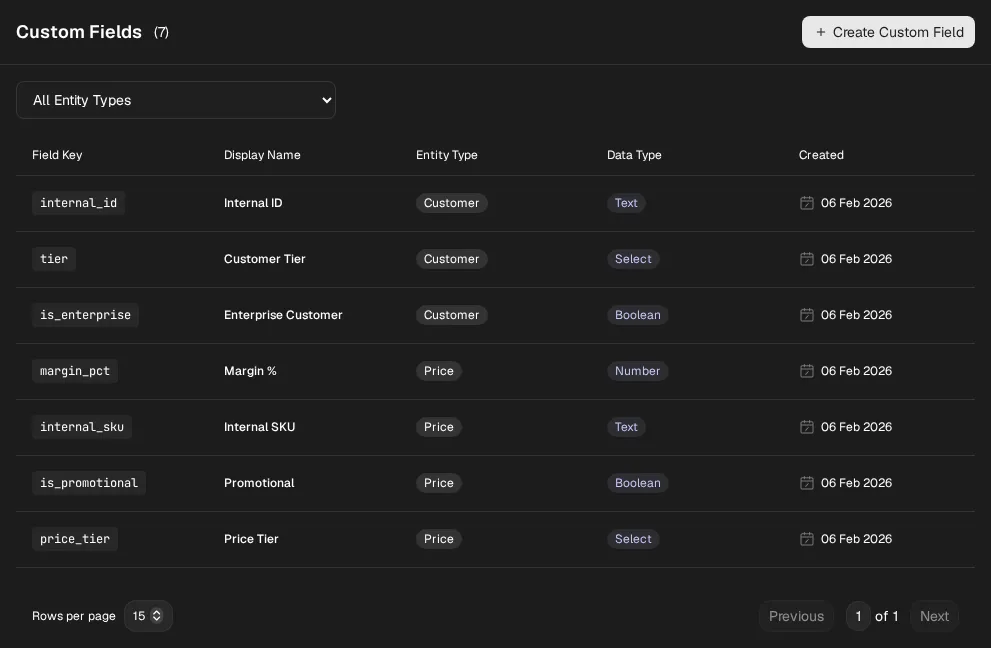
For select fields, you can add new options when editing, but you cannot remove options that are in use. Existing options in the edit form are disabled to prevent accidental removal.
List view visibility
Each custom field definition has a “Show in List View” setting that controls whether the field appears as a column in entity list views:
This is useful when you have many custom fields but only want a subset visible in tables.
Viewing and editing values on entities
Custom field values can be viewed and edited directly on entity detail pages. For example, on a Price detail page:
- The Custom Fields section displays all current values for that price
- Click Edit to open a side panel titled “Edit Custom Fields” with a form for all defined price custom fields
- Each field type renders an appropriate input (text input, number input, select dropdown with clearable support, or toggle switch for booleans)
- Clear a field to remove its value
- Click Save Changes to persist changes, or Cancel to discard
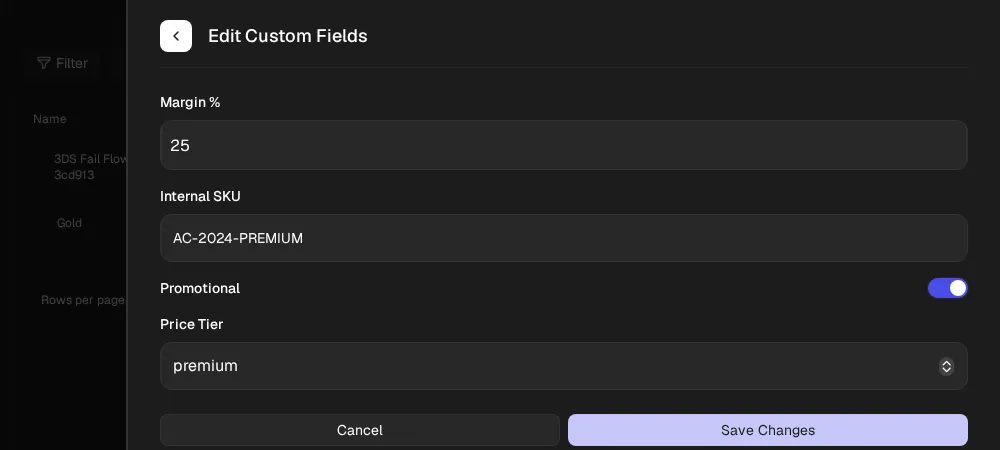
The Custom Fields section only appears if there are custom field definitions for that entity type. If no definitions exist, the section is hidden. When the section is visible but no values are set, it displays “No custom field values set.”
Filtering by custom fields
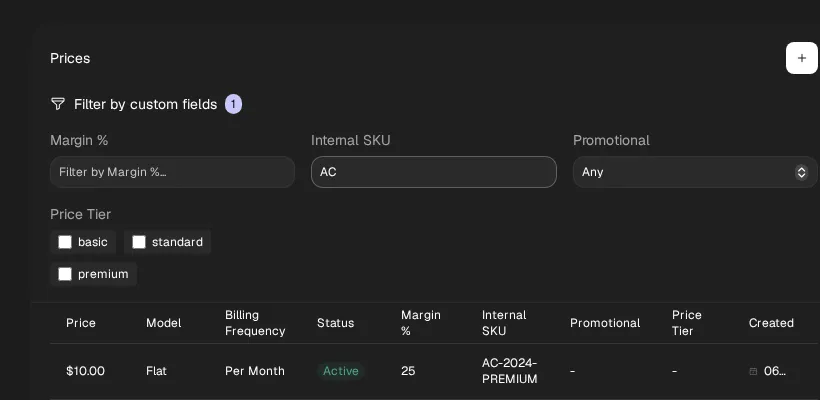
In list views (like the Prices table on a Product detail page), you can filter by custom field values:
- Click Filter by custom fields to expand or collapse the filter panel
- Filter controls appear for each visible custom field:
- Text fields — Type to filter (case-insensitive substring match)
- Number fields — Enter a number to filter (partial match)
- Boolean fields — Select “Yes”, “No”, or “Any”
- Select fields — Check one or more options (prices matching ANY selected option are shown)
- A badge next to the button shows the number of active filters (filters with at least one value selected)
Creating field definitions
Before storing values, create a field definition to establish the schema.
See Create Custom Field Definition for the full API reference.
Field definition examples
Text field
Number field
Boolean field
Select field
Listing field definitions
Retrieve all definitions for your account, optionally filtered by entity type.
See List Custom Field Definitions for the full API reference.
Setting custom field values
Set values when creating or updating entities by including a custom_fields object in your request body:
See Create Customer or Update Customer for examples. The same pattern applies to all supported entity types.
You can also set and update custom field values directly in the Business Portal. See Viewing and editing values on entities.
Updating custom fields on immutable entities
Some entities like prices are immutable after creation—you cannot change their core properties. However, custom fields can still be updated via the PATCH endpoint:
See Update Price for the full API reference.
Reading custom field values
Custom fields are returned when you expand them in your request using ?expand=custom_fields:
Without the expand=custom_fields parameter, custom fields are not included in the response to keep payloads small. To expand multiple fields, use expand=custom_fields,other_field.
See Get Customer for the full API reference.
Clearing field values
Set a field to null to remove its value:
See Update Customer for the full API reference.
Updating field definitions
You can update display_name, description, constraints, and is_visible_in_list on existing definitions.
You cannot change the field_key, data_type, or entity_type of an existing definition. Create a new definition instead.
See Update Custom Field Definition for the full API reference.
Updating select field options
When updating a select field’s options, you can add new options freely. However, you cannot remove options that are currently in use. If any entity has a value set to an option you’re trying to remove, the update will fail with a 422 error: "Cannot remove select options that are in use: ['option1', 'option2']".
To remove an option:
- First update all entities using that option to a different value
- Then update the definition to remove the option
Deleting field definitions
Deleting a definition removes all associated values across all entities. This is a destructive operation. The confirm_field_key parameter must match the definition’s field key to prevent accidental deletion. If the keys don’t match, the request fails with a 400 error. The response includes an X-Deleted-Values-Count header showing how many values were deleted.
See Delete Custom Field Definition for the full API reference.
Validation
Custom fields are validated on write:
Example error response:
Test and live mode
Custom field definitions are scoped to your account and are separate between test and live modes. Definitions you create in test mode won’t appear in live mode and vice versa. This lets you safely experiment with field schemas in test mode before creating them in production.
Webhooks
Custom field changes are included with the parent entity’s webhook events. For example, when you update a customer’s custom fields, the customer.updated webhook will include the updated custom_fields in the payload. There are no separate webhook events for custom field changes.